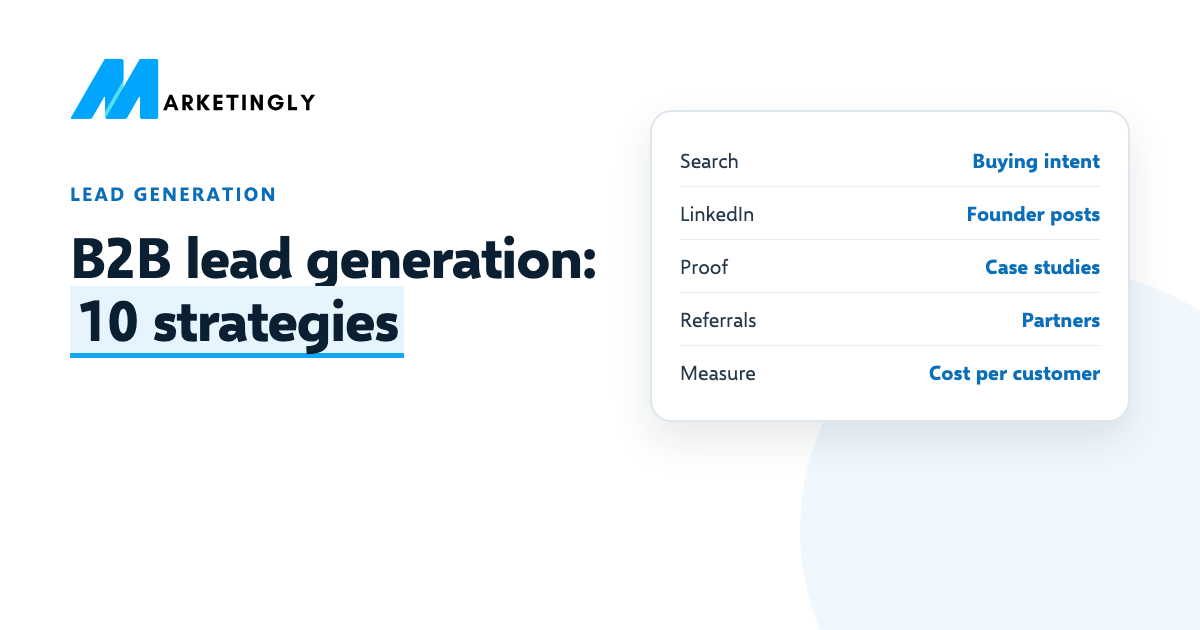
The B2B lead generation strategies that work best are the ones that reach buyers when they are already looking for a solution: search, comparisons, referrals and specific offers on LinkedIn, backed by proof such as case studies. Below are 10 strategies, who each one reaches, how to start and what to measure, plus how to track leads so you know which ones bring customers and not just form fills.
Want a team to set up and run this? See our LinkedIn marketing, SEO and PPC services.
In short
- Start with the buyers who are already searching: SEO for buying searches and Google Ads on high-intent terms.
- Build trust in parallel: founder posts on LinkedIn, case studies and free tools.
- Judge every channel by cost per qualified lead and cost per customer, not by the number of leads.
- Track the source of every lead in your CRM from day one.
What is B2B lead generation? #
B2B lead generation is the work of finding businesses that could buy from you and getting the right people inside them to show interest, for example by asking for a quote, booking a call, starting a trial or downloading something useful. A lead is a person and company you can follow up with; a customer is what you want at the end.
It differs from selling to consumers in a few ways: fewer, larger deals; several people involved in each decision; longer timelines; and more need for proof before anyone signs. That is why B2B lead generation leans on search, LinkedIn, case studies and personal follow-up more than on impulse offers.
Types of B2B leads #
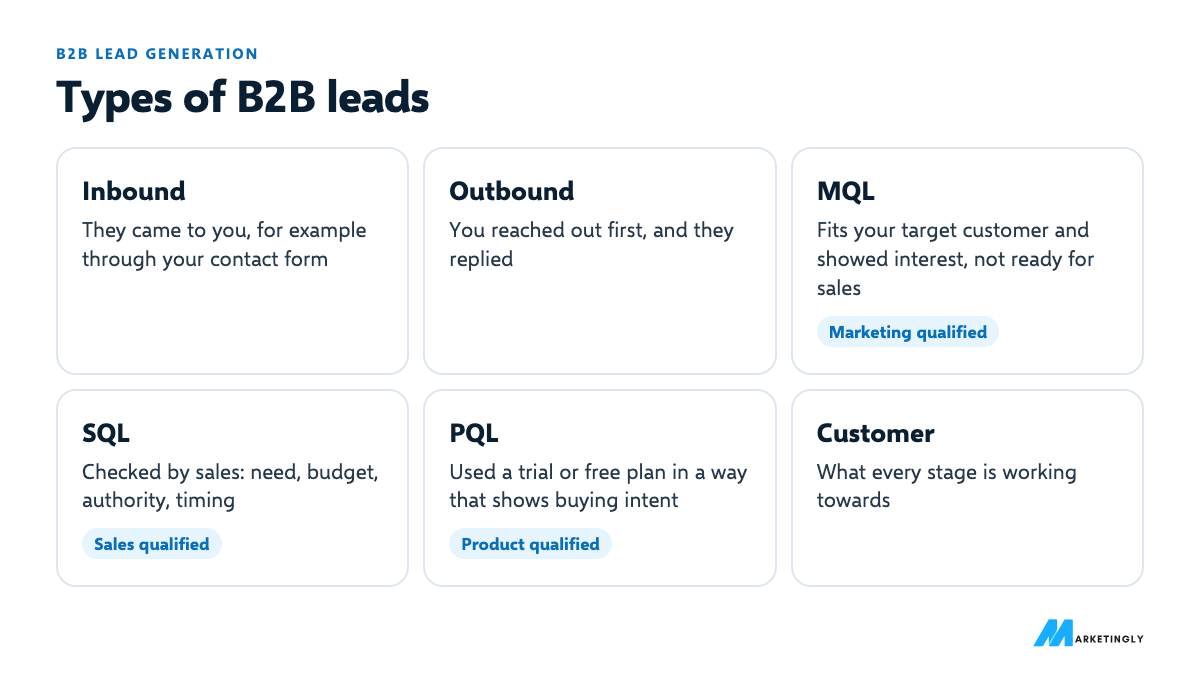
| Type | What it means | Example |
|---|---|---|
| Inbound lead | They came to you | Filled in your contact form after reading a guide |
| Outbound lead | You reached out first | Replied to a personal LinkedIn message |
| Marketing qualified lead (MQL) | Fits your target customer and has shown interest, but is not ready to talk to sales | Downloaded a checklist from a company your size |
| Sales qualified lead (SQL) | Checked by sales: real need, budget, authority and timing | Asked for a proposal for next quarter |
| Product qualified lead (PQL) | Used a free trial or plan in a way that shows buying intent | Invited five colleagues during a trial |
Agree on these definitions with your sales team in writing. Most arguments between marketing and sales are really arguments about what a “lead” is.
The B2B lead generation process #
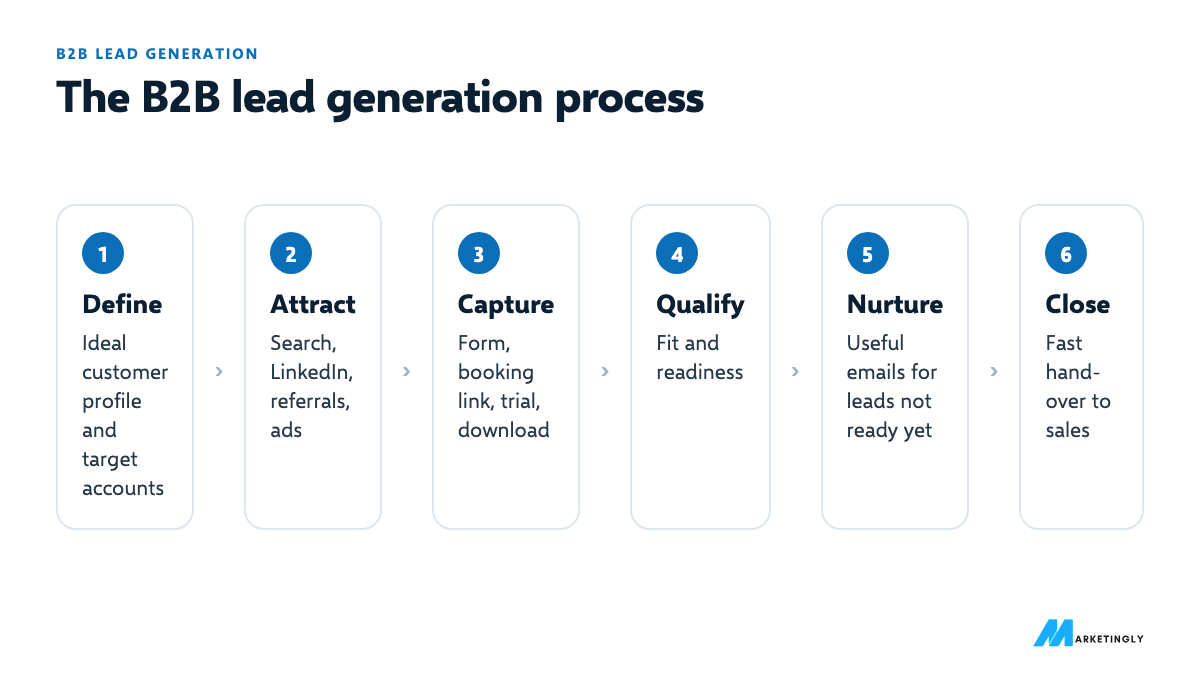
- Define who you want: your ideal customer profile and, for larger deals, a list of target accounts.
- Attract them: search, LinkedIn, referrals, events, ads.
- Capture interest: a contact form, a booking link, a trial, a useful download.
- Qualify: check fit and readiness, by form questions, scoring or a short call.
- Nurture: stay useful to leads who are not ready yet, with emails and content.
- Hand over and close: pass qualified leads to sales quickly, with everything known about them.
Define your ideal customer profile and target accounts #
| Question | Example answer |
|---|---|
| Industry | Software companies selling to other businesses |
| Company size | 20 to 200 employees |
| Region | UK and US |
| Buyer and influencers | Head of Marketing (buyer), founder (approves), marketing manager (uses) |
| Trigger events | New funding, a new marketing hire, a website relaunch |
| Problems they mention | “Our leads come only from referrals” |
| Signs they are a bad fit | No budget for outside help, or want only the cheapest option |
For high-value deals, turn the profile into a named list of 50 to 200 target companies, and research who in each company you need to reach.
Account-based marketing for large deals #
When a single client is worth a lot, it can pay to treat each target company as a market of one. That approach is called account-based marketing (ABM):
- Choose the accounts: a short list of companies that fit your ideal customer profile best.
- Map the people: the buyer, the users, and whoever signs off, using LinkedIn and the company website.
- Research each account: recent news, hires, problems they talk about in public.
- Reach out with something specific to them: a short review of their website, a relevant case study, an idea for their market.
- Stay visible: connect on LinkedIn, comment on their posts, and use LinkedIn Ads aimed at those companies if the budget allows.
- Measure by account: meetings booked, people engaged, opportunities opened.
10 B2B lead generation strategies #
1. SEO for buying searches #
- Reaches: Buyers searching for a solution, a provider or a comparison.
- How to start: List the searches that show buying intent (“[service] for [industry]”, “[tool] alternatives”, “[service] pricing”) and build one strong page for each. See SEO service.
- Measure: Enquiries from organic search, by page.
2. Comparison and alternatives pages #
- Reaches: Buyers with a shortlist.
- How to start: Write honest comparisons of you and the options buyers weigh, including when the other option is better.
- Measure: Enquiries and demo requests from those pages.
3. Founder and team posts on LinkedIn #
- Reaches: Decision-makers who follow people more than companies.
- How to start: Post two or three times a week about one topic your buyers care about, from the founder’s profile. See 30 LinkedIn post ideas.
- Measure: Profile visits, inbound messages, replies.
4. Personal LinkedIn outreach #
- Reaches: A defined list of target accounts.
- How to start: Send a short, specific connection note and start a conversation; never pitch in the first message. Do not use automation tools: LinkedIn’s User Agreement does not allow them. See connection request templates.
- Measure: Acceptance rate, replies, meetings booked.
5. Google Ads on high-intent searches #
- Reaches: People searching for your service right now.
- How to start: Bid on a short list of buying searches, send each to a matching landing page, and track enquiries, not clicks. See PPC service.
- Measure: Cost per lead, cost per qualified lead.
6. LinkedIn Ads with lead forms #
- Reaches: Buyers by job title, industry and company size.
- How to start: Offer something specific (a checklist, an audit, a guide) and use a short form.
- Measure: Cost per lead, share of leads that are qualified.
7. Free tools and templates #
- Reaches: People solving the problem you solve.
- How to start: Build a calculator, checklist or template your buyers use, with no email gate, and link it from related pages. See our ROAS calculator.
- Measure: Visits, links earned, enquiries from the tool page.
8. Case studies #
- Reaches: Buyers who need proof before they talk to you.
- How to start: Show one real project: the problem, what you did, real numbers and what you learned. See our case studies.
- Measure: Case study views before enquiries.
9. Webinars and events #
- Reaches: Buyers who want to learn before they buy.
- How to start: Run a practical session on one problem, with a clear next step for people who want help.
- Measure: Registrations, attendees, meetings booked afterwards.
10. Referrals and partners #
- Reaches: Customers and businesses that already trust you.
- How to start: Ask happy clients for introductions, and partner with firms that serve the same buyers with a different service.
- Measure: Referred leads and how often they close.
What each strategy looks like in practice #
- SEO for buying searches: An HR consultancy writes “HR outsourcing for startups”, with prices, process and a case study.
- Comparison pages: A project management tool publishes an honest “[Tool] vs spreadsheets” page, including when a spreadsheet is enough.
- Founder posts: An agency founder posts weekly about what they see in clients’ ad accounts, with real (anonymised) examples.
- Personal outreach: A cyber security firm contacts IT managers at 100 companies that just opened a new office, with a short, relevant checklist.
- Google Ads: An accountancy firm bids only on “[city] accountant for small business” and similar searches, with a landing page per service.
- LinkedIn Ads: A SaaS company offers a benchmark template to finance managers in its target industry, using a short lead form.
- Free tools: A logistics company publishes a free shipping cost calculator and links it from every service page.
- Case studies: A web agency writes up one client project per quarter with before-and-after numbers.
- Webinars: A payroll provider runs a 30-minute session on new payroll rules each year, then follows up with attendees.
- Referrals and partners: A bookkeeping firm and a tax advisor send each other clients who need the other’s service.
Lead generation by type of B2B business #
| Business | What usually works first |
|---|---|
| SaaS companies | Search for the category and alternatives, free trials, comparison pages, founder posts on LinkedIn and integration listings. See our SaaS marketing strategy. |
| Professional services (accountants, lawyers, consultants) | Referrals, Google Business Profile and reviews for local searches, service pages for each specialism, and LinkedIn posts from the partners. Example: how to get tax clients. |
| Marketing and creative agencies | Case studies, niche service pages (“[service] for [industry]”), founder content, partnerships with complementary agencies, and free tools that show expertise. |
| IT and managed services | Local search, service pages for each problem (backups, security, support), audits or health checks as an offer, and partnerships with software vendors. |
| Manufacturers and industrial suppliers | Product and application pages that match technical searches, trade directories, trade shows, distributor partnerships and downloadable spec sheets. |
These are starting points, not rules. Your own tracking will show which channels bring customers for your business.
Which strategy should you start with? #
| Your situation | Start with |
|---|---|
| You need leads this month | Google Ads on high-intent searches, personal LinkedIn outreach, referrals |
| You can wait a few months and want lower costs later | SEO for buying searches, comparison pages, free tools |
| Buyers do not know you yet | Founder posts on LinkedIn, webinars, case studies |
| You sell a few large deals a year | Personal outreach to a target list, partners, case studies |
Step-by-step playbooks for the top strategies #
SEO pages that bring enquiries #
- List your services and the industries you serve.
- For each, find the searches that show buying intent: “[service] for [industry]”, “[service] agency”, “[service] pricing”, “[competitor] alternative”.
- Write one page per search, answering the question better than the pages already ranking: what you do, for whom, how it works, price ranges if you can, proof and a clear next step.
- Link these pages from your homepage, service pages and related articles.
- Track enquiries by page, and improve the pages that get visits but no enquiries.
Google Ads for B2B #
- Start with a short list of high-intent searches, not broad terms.
- Separate campaigns for your brand, competitors, services and problems, so costs are clear.
- Add negative keywords early: jobs, free, courses, definitions, templates (unless you want them).
- Send each ad group to a page that matches the search, with a short form.
- Track form fills and calls as conversions, and import which ones became customers if you can.
Our free ROAS calculator helps you work out what return a campaign needs to make money.
A personal LinkedIn outreach sequence #
Connection note
Hi [Name], I saw your post on [topic]. I work with [type of company] on [problem], and your point about [detail] matched what we see. Happy to connect.
After they accept (wait a few days)
Thanks for connecting, [Name]. We put together [a short guide / a checklist] on [problem]. Want me to send it? No call needed.
If they reply with interest
Here it is: [link]. If it would help to talk through how it applies to [Company], here is my calendar: [link].
One gentle follow-up, if no reply
Hi [Name], just in case this got buried: happy to send the [guide] on [problem] if it is useful. Either way, good luck with [something specific].
Send these by hand, to people you have a real reason to contact. More templates: 20 connection request messages.
A case study that sells #
- The client and the problem, in their words.
- What you did, step by step, without jargon.
- The result, with real numbers and the time it took.
- A quote from the client, approved by them.
- What you learned and what another business could take from it.
- A next step for readers with the same problem.
See our SEOSage case study for the format.
Free tools and templates #
Think of a calculation or document your buyers make again and again, and make it easier: a cost calculator, a checklist, a template, a grader. Keep it free and ungated, so people share and link to it, and add a soft next step for those who want help. Ideas: a budget calculator for an ad agency, a contract template for an HR consultancy, an audit checklist for an IT firm.
A webinar people actually attend #
- Pick one specific problem your buyers have this quarter.
- Keep it to 30 to 45 minutes, with most of the time on practical steps.
- Invite your list, post on LinkedIn, and ask a partner to co-host.
- Send the recording to everyone who registered, attended or not.
- Follow up personally with attendees who asked questions.
A simple referral process #
After a client success, ask directly: “Do you know one other [type of business] who has the same problem we just solved for you?” Make it easy with a short intro email they can forward, thank them whatever happens, and keep a list of who referred whom so you can say thank you properly when it turns into work.
A 4-week LinkedIn content plan for lead generation #
Three posts a week from the founder or a senior person: one that teaches, one that proves, one that starts a conversation.
- Week 1. Teach: the most common mistake your buyers make. Prove: a short client result, with permission. Conversation: ask what they find hardest about the problem.
- Week 2. Teach: a three-step how-to. Prove: behind the scenes of how you work. Conversation: a poll with a reason for asking.
- Week 3. Teach: a myth in your industry. Prove: a lesson from a project that went wrong. Conversation: your take on a recent change in the industry.
- Week 4. Teach: a checklist or template. Prove: a number from your own work. Conversation: ask for recommendations on a tool or process.
Post from the founder’s or a senior person’s profile, reply to every comment, and follow up personally with buyers who engage. For more topics, see our 30 LinkedIn post ideas.
Offers that work in B2B #
“Contact us” asks a lot of a stranger. Smaller, specific offers get more people to raise their hand:
- A free audit or review of something specific: a website, an ad account, a process.
- A short consultation with a clear agenda and something useful at the end, such as a written plan.
- A calculator or template they can use straight away.
- A price guide that explains what affects the cost of your service.
- A trial or pilot for a defined period or a small piece of work.
Match the offer to how ready the buyer is. A price guide suits someone comparing providers; a checklist suits someone still learning about the problem.
Landing pages and forms that convert #
- One page, one goal. Remove menus and links that distract from the form where you can.
- A headline that matches the ad or search that brought people there.
- Proof next to the form: a short case study, a quote, logos you have permission to use.
- Only the fields you need to follow up: name, work email, company, and one qualifying question.
- Say what happens next: “We reply within one working day with a short plan.”
- Fast and easy on a phone. Test the page and the form on a phone as well as a computer.
A simple lead scoring model #
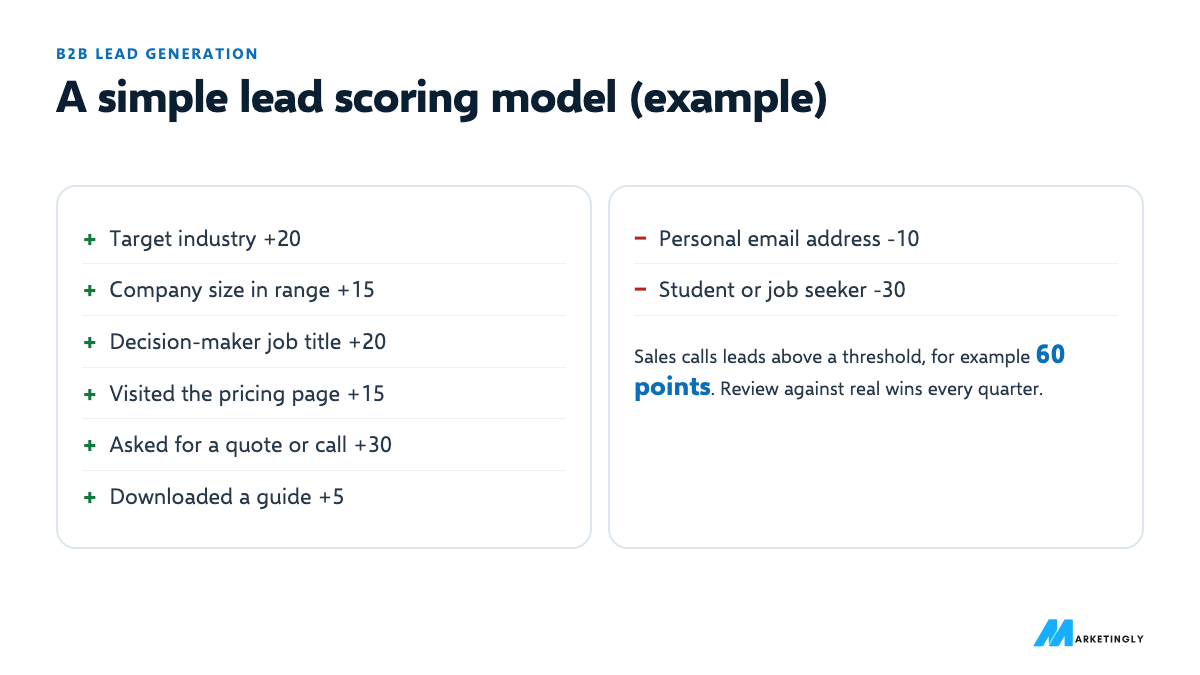
Lead scoring gives each lead points for fit and interest, so sales calls the best ones first. An example to adapt:
| Signal | Points |
|---|---|
| Company in your target industry | +20 |
| Company size in your range | +15 |
| Job title is a decision-maker | +20 |
| Visited the pricing page | +15 |
| Asked for a quote or call | +30 |
| Downloaded a guide | +5 |
| Personal email address (no company) | -10 |
| Student or job seeker | -30 |
Pick a threshold, for example 60, above which sales calls the lead. Review the scores against real wins every quarter and adjust.
Follow up fast, and keep following up #
- Reply the same working day to every enquiry, even if only to book a time.
- Use the channel they used: a form gets an email and a call; a LinkedIn message gets a LinkedIn reply.
- Try a few times over two weeks before you stop, with something useful each time.
- Record every attempt in your CRM, so nobody contacts the same lead twice in one day.
Questions to qualify a lead on the first call #
- What made you start looking now?
- What have you tried so far, and what happened?
- What would a good result look like in six months?
- Who else is involved in the decision?
- Is there a budget set aside, or a range you have in mind?
- When do you need this in place?
- What would stop this from going ahead?
- How will you choose between providers?
You do not need every answer on the first call. Two or three clear answers usually show whether it is worth a proposal, and save both sides time when it is not.
A nurture email sequence for leads who are not ready #
- Day 0: what they asked for, plus one useful tip.
- Day 3: a short case study from a similar company.
- Day 7: the most common mistake you see, and how to avoid it.
- Day 14: answers to the questions buyers ask before choosing a provider.
- Day 21: a free tool, template or checklist.
- Day 30: a simple question: “Is [problem] still a priority this quarter?”
Every email should be useful on its own, with an easy way to reply or unsubscribe.
How to track B2B leads properly #
- Tag every link you share in ads, emails and posts with UTM parameters, so the source arrives with the visit.
- Save the source with each lead in your CRM, from the form or by asking “how did you hear about us?” on the first call.
- Mark which leads are qualified: the right company, the right person, a real need and a budget.
- Follow each lead to the end: meeting, proposal, won or lost.
- Compare channels monthly on cost per qualified lead and cost per customer.
A worked example #
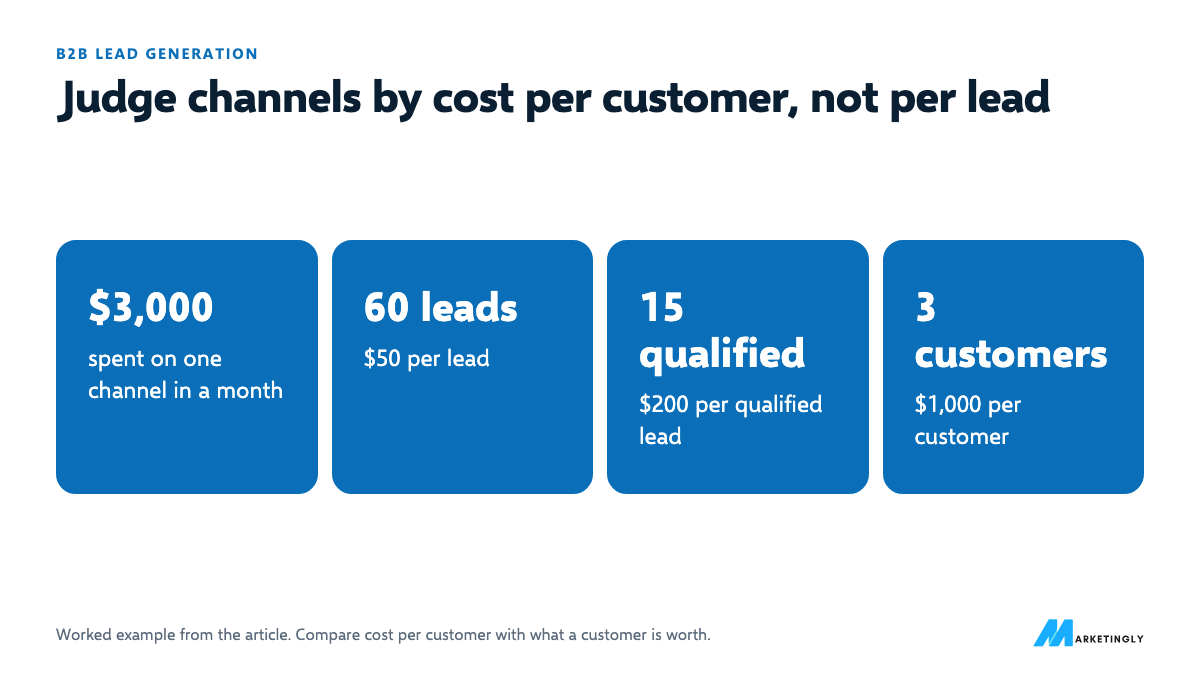
Say a channel costs $3,000 in a month and brings 60 leads, of which 15 are qualified and 3 become customers.
- Cost per lead: $3,000 / 60 = $50.
- Cost per qualified lead: $3,000 / 15 = $200.
- Cost per customer: $3,000 / 3 = $1,000.
A second channel with $100 leads might still be better if more of them become customers. That is why cost per customer, compared with what a customer is worth, is the number that decides where the budget goes.
How to measure lead quality #
| Measure | What it tells you |
|---|---|
| Share of leads that are qualified | Whether a channel reaches the right companies and people |
| Share of qualified leads that get a proposal | Whether the need is real and the offer fits |
| Win rate on proposals | Whether your pricing, proof and sales process work |
| Average deal size by channel | Which channels bring the most valuable customers |
| Time from lead to customer | How long each channel takes to pay off |
A channel with fewer leads but a higher win rate and larger deals can be the best one you have. Lead counts alone hide that.
Signs your lead generation is working #
- Sales spends its time on good-fit conversations, not on chasing people who were never going to buy.
- You can name the source of most new customers from the last quarter.
- Cost per customer is stable or falling as you spend more, not rising sharply.
- Buyers arrive better informed, mentioning a case study, an article or a LinkedIn post.
- Fewer deals depend on one channel, such as referrals alone, so a quiet month in one place does not empty the pipeline.
Get marketing and sales to agree #
- Shared definitions of MQL, SQL and a qualified opportunity.
- A hand-over rule: what information comes with each lead, and how fast sales responds.
- Feedback both ways: sales marks why leads were not a fit, so marketing can fix targeting.
- One shared report of leads, opportunities and revenue by source, reviewed monthly.
How to split your budget #
Put most of the budget on the channels already proven to bring customers at a cost you can afford, a smaller share on improving them, and a little on testing something new. Move money every month based on cost per customer, not on which channel feels busiest. If nothing is proven yet, start with small, tracked tests in two channels and let the results decide.
A 90-day B2B lead generation plan #
| When | What to do |
|---|---|
| Weeks 1 to 2 | Write the ideal customer profile and lead definitions. Set up tracking, UTM tags and the CRM source field. |
| Weeks 3 to 4 | Fix the website basics: service pages, one landing page per offer, short forms, fast replies. |
| Month 2 | Start one fast channel (Google Ads or outreach) and one slow one (SEO pages or founder posts). Write the first case study. |
| Month 3 | Add the nurture sequence and lead scoring. Review cost per qualified lead and per customer, then move budget. |
Tools you need (and what for) #
| Job | Examples |
|---|---|
| Keep track of leads and deals | A CRM such as HubSpot or Pipedrive |
| See where visits and leads come from | Google Analytics, Google Search Console |
| Capture leads | Your website forms, a booking calendar |
| Send nurture emails | Your CRM’s email tool or an email platform |
| Reach buyers by job title | LinkedIn, LinkedIn Ads |
Start with the fewest tools that do the job. A spreadsheet is a fine CRM for your first twenty leads.
Privacy and consent basics #
Rules on contacting people and storing their data depend on where they are, for example GDPR in the UK and EU and CAN-SPAM in the US. As a minimum: collect only the data you need, say clearly what you will do with it, give an easy way to unsubscribe from emails, and keep your contact lists secure. Check the rules for the countries you sell to, or ask an adviser.
Common B2B lead generation mistakes #
- Chasing lead volume. Hundreds of unqualified leads waste sales time.
- Gating everything. Asking for an email before people can read anything puts off buyers who are not ready to talk yet. Gate only things worth a conversation, such as an audit.
- Slow follow-up. A lead who waits days for a reply may already be talking to someone else.
- Buying lists and mass emailing. It can hurt your email sender reputation and can break privacy and anti-spam laws in many countries.
- Automation on LinkedIn. LinkedIn’s User Agreement does not allow bots or automated tools for connecting and messaging, and accounts can be restricted.
B2B lead generation checklist #
- Our ideal customer profile and lead definitions are written down and agreed with sales.
- Every lead has a source recorded in the CRM.
- We have a page for each main service and each industry we target.
- Forms are short, and say what happens next.
- Every enquiry gets a reply the same working day.
- Leads who are not ready get a useful nurture sequence.
- We have at least one case study with real numbers.
- The founder or a senior person posts on LinkedIn every week.
- We ask happy clients for referrals after every success.
- We compare channels on cost per qualified lead and cost per customer every month.
Questions about B2B lead generation #
What is the best B2B lead generation strategy? #
The one that reaches your buyers when they are already looking. For most B2B companies that means SEO and paid search on buying searches, plus referrals, with LinkedIn and case studies building trust alongside.
What is a qualified lead in B2B? #
A lead from the right kind of company, in a role that can buy or influence the decision, with a real need and a realistic budget and timeline. Write your own definition down so marketing and sales use the same one.
How long does B2B lead generation take to work? #
Paid search and outreach can bring conversations within weeks. SEO, content and free tools usually take several months but keep working without paying for each click.
Is LinkedIn good for B2B lead generation? #
Yes, because you can reach people by job title, industry and company size. It works best when the founder or team post regularly and outreach is personal, not automated.
What is the difference between inbound and outbound lead generation? #
Inbound brings buyers to you, through search, content, LinkedIn posts and referrals. Outbound is when you contact them first, through personal outreach, calls or ads aimed at them. Most B2B companies use both: inbound for steady demand, outbound for specific target accounts.
How many leads do I need? #
Work backwards from your revenue goal. If you need 4 new clients a month, 1 in 4 proposals wins, and 1 in 3 qualified leads gets a proposal, you need about 48 qualified leads a month. Use your own numbers, then plan channels to reach that.
Does cold email still work for B2B? #
Short, personal emails to well-chosen people can still start conversations. Mass emails to bought lists rarely do, can hurt your sender reputation and may break privacy laws. If you send cold email, keep it relevant, honest and easy to opt out of.
What is account-based marketing? #
Account-based marketing treats a short list of high-value target companies as individual markets, with research, outreach and content tailored to each one and the people involved in the decision.
How much does B2B lead generation cost? #
It depends on your market and channels, so measure your own cost per qualified lead and per customer rather than relying on averages. Compare the cost of winning a customer with what that customer is worth over time.
Should I buy B2B lead lists? #
Usually not. Bought lists are often out of date, the people on them did not ask to hear from you, and emailing them can break privacy and anti-spam rules in many countries. A smaller list you build yourself, of companies that fit your ideal customer profile, works better.
More ideas by industry: real estate lead generation and how to get tax clients.