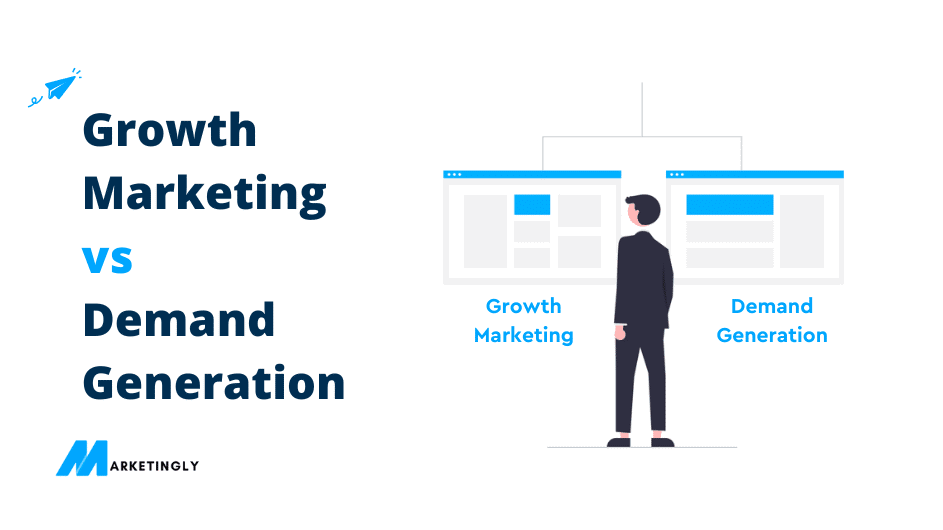
As a business owner or marketing professional, you’ve likely heard the terms “Demand Generation” and “Growth Marketing” thrown around quite a bit. But what do these terms really mean, and how do they differ from one another?
The short answer: demand generation creates interest and pipeline for a sales team, mostly at the top and middle of the funnel, and is judged on qualified leads and pipeline. Growth marketing runs quick experiments across the whole customer journey, from first visit to renewal, and is judged on sign-ups, activation, retention and revenue per customer. Sales-led B2B companies usually need demand generation first; product-led companies with self-serve sign-ups usually need growth marketing first.
In this blog post, we’ll delve into the differences between demand generation and growth marketing, exploring their key characteristics, tactics, and goals. We’ll also look at when it might make sense to use one approach over the other, and how these two approaches can be used together in a holistic marketing strategy.
By the end of this post, you’ll have a clear understanding of the differences between demand generation and growth marketing, and you’ll be able to determine which approach is best suited to your business needs.
Below is a list of all the topics we will cover in this guide. Go ahead and click on any of these links, and you’ll be taken to that specific section.
- What is Growth Marketing?
- Key areas of Growth Marketing
- What is Demand generation?
- Key areas of Demand Generation
- Difference between Demand generation vs Growth Marketing
- How do you measure each one?
- Which one do you need first?
- Demand generation vs other marketing terms
- Conclusion
- Frequently asked questions about Demand Generation and Growth Marketing
What is Growth Marketing? #
Growth marketing is a data-driven approach to marketing that focuses on continuously testing and optimizing marketing campaigns to drive sustainable, long-term growth. It involves a continuous cycle of testing, analyzing, and optimizing marketing efforts based on data, in order to drive growth over time.
Growth marketing is often focused on the entire marketing funnel, from attracting new customers to retaining and upselling existing ones. It may involve a variety of tactics, including A/B testing, customer research, and analytics, and it often involves collaboration across teams, such as marketing, product, and engineering.
There are several key areas of Growth Marketing, including: #
- Customer acquisition: Growth marketing often focuses on attracting new customers through targeted marketing campaigns and tactics, such as paid advertising, content marketing, and social media marketing.
- Customer retention: Growth marketers also focus on retaining existing customers and increasing their lifetime value through tactics such as email marketing, upselling, and customer loyalty programs.
- Product and market fit: Growth marketers work to understand the needs and preferences of their target customers, and they use this information to optimize and improve their product offerings.
- Data-driven decision-making: Growth marketers rely heavily on data to inform their marketing decisions, using tools such as analytics and A/B testing to understand what works and what doesn’t.
- Collaboration across teams: Growth marketing often involves collaboration across teams, such as marketing, product, and engineering, in order to drive growth.
What is Demand generation? #
Demand generation is the process of creating awareness and interest in a product or service in order to generate leads and sales. It involves identifying potential customers and creating demand for a company’s products or services through targeted marketing campaigns. Some common tactics used in demand generation include email marketing, social media marketing, content marketing, and events.
The goal of demand generation is to increase the number of leads and sales for a company, and it is often focused on the top of the marketing funnel, helping to attract and engage potential customers. Demand generation can be particularly effective for companies that have a new product or service to introduce to the market, or for companies that are looking to expand their customer base.
There are several key areas of Demand Generation, including: #
- Targeting specific customer segments: By identifying and targeting specific customer segments, companies can create more targeted and effective demand-generation campaigns.
- Using a variety of marketing channels: A multichannel approach can help reach potential customers through a variety of channels, including email, social media, and content marketing.
- Providing valuable content: Providing valuable and informative content can help attract potential customers and engage them with a company’s offerings.
- Measuring and tracking results: It’s important to measure and track the results of demand generation efforts in order to understand what’s working and what’s not and to continually improve and optimize campaigns.
- Collaborating across teams: Demand generation often involves collaboration across teams, such as marketing, sales, and customer service, in order to effectively reach and engage potential customers.
Difference between Demand generation vs Growth Marketing #
Demand generation and growth marketing are two closely related but distinct approaches to marketing. Here are some key differences between the two:
| Demand generation | Growth marketing | |
|---|---|---|
| Main goal | Interest and pipeline for sales | More customers, and more value from each one |
| Funnel stage | Top and middle: awareness to sales-ready lead | The whole journey: first visit to renewal |
| Working rhythm | Campaigns and content programmes over quarters | Short experiments, often weekly |
| Typical channels | Content, events, webinars, LinkedIn, paid search, email nurture | Landing page and onboarding tests, referral loops, email, paid acquisition |
| Main metrics | Qualified leads, pipeline created, cost per opportunity | Sign-ups, activation, retention, customer lifetime value |
| Works most with | Sales and sales development | Product, engineering and data |
| Best fit | Sales-led B2B with longer sales cycles | Product-led or self-serve products with steady traffic |
- Focus: Demand generation is focused on creating demand for a company’s products or services, while growth marketing is focused on driving sustainable, long-term growth through data-driven, iterative marketing efforts.
- Marketing funnel: Demand generation is often focused on the top of the marketing funnel, helping to attract and engage potential customers, while growth marketing is often focused on the entire marketing funnel, from attracting new customers to retaining and upselling existing ones.
- Tactics: Demand generation may involve tactics such as email marketing, social media marketing, content marketing, and events, while growth marketing may involve tactics such as A/B testing, customer research, and analytics.
- Data-driven decision-making: Growth marketing relies heavily on data to inform marketing decisions, using tools such as analytics and A/B testing to understand what works and what doesn’t. Demand generation may also use data to inform its decisions, but it may not be as data-driven as growth marketing.
- Collaboration: Demand generation often involves collaboration across teams, such as marketing, sales, and customer service, while growth marketing often involves collaboration across a wider range of teams, such as marketing, product, and engineering.
How Do You Measure Each One? #
Demand generation is measured by what it hands to sales:
- Qualified leads (MQLs and SQLs) and how many become opportunities.
- Pipeline created from marketing, in value and number of deals.
- Cost per opportunity and cost per customer won.
- Growth in searches for your brand name, a sign that awareness is building.
Growth marketing is measured by what happens at each step of the journey:
- Conversion rate at each step: visit to sign-up, sign-up to active user, active user to paying customer.
- Retention and churn: how many customers stay each month.
- Customer lifetime value and how long it takes to earn back the cost of winning a customer.
- How many experiments you run, and how many of them win.
Which One Do You Need First? #
Four questions usually settle it:
- How do customers buy? If they talk to sales before they buy, start with demand generation. If they sign up and pay on their own, start with growth marketing.
- How long is the sales cycle? Long cycles with several decision makers favour demand generation, because experiments take too long to read.
- How many possible buyers are there? A short list of target accounts suits focused demand generation. A large market suits growth experiments.
- Do you have the volume to test? Growth experiments need enough visitors and sign-ups each week to show a clear winner. Without that, spend the effort on demand first.
Many companies end up doing both: demand generation fills the pipeline, and growth marketing makes more of the people who arrive.
Demand Generation vs Other Marketing Terms #
Demand generation vs digital marketing #
Digital marketing is the set of online channels: search, social, email, ads and websites. Demand generation is a goal and a way of working that uses those channels, and offline ones such as events, to build interest and pipeline. Most demand generation today is done through digital marketing.
Demand generation vs product marketing #
Product marketing decides what the product is, who it is for and how it is described: positioning, messaging and launches. Demand generation takes that message to the market and turns it into leads. When the two teams agree on the message, campaigns convert better.
Demand generation vs content marketing #
Content marketing is one of the main tools of demand generation: articles, guides, videos and webinars that attract and teach buyers. Demand generation also covers paid channels, events and lead nurturing, and is judged on pipeline rather than views.
Demand generation vs performance marketing #
Performance marketing pays for measurable actions, such as clicks, sign-ups or sales, and is judged on cost per result. Demand generation also invests in awareness that does not pay back straight away, such as content and events, because B2B buyers often research for months before they are ready to talk.
Conclusion #
In conclusion, demand generation and growth marketing are two distinct yet closely related strategies that businesses can use to drive growth and increase revenue. Demand generation focuses on attracting and nurturing leads through targeted marketing efforts, while growth marketing is a data-driven approach that seeks to identify and optimize the key drivers of growth for a business. Both strategies can be effective in their own right, but the best results are often achieved by combining them and taking a holistic approach to marketing and growth. Ultimately, the right strategy for your business will depend on your specific goals, target audience, and resources. By understanding the differences between demand generation and growth marketing, you can make informed decisions about which tactics and strategies are best suited to your business and your growth goals.
Here are some frequently asked questions about Demand Generation and Growth Marketing: #
What is the main difference between demand generation and growth marketing? #
The main difference between demand generation and growth marketing is their focus. Demand generation is focused on creating demand for a company’s products or services, while growth marketing is focused on driving sustainable, long-term growth through data-driven, iterative marketing efforts
Which is more important: Demand Generation or Growth Marketing? #
Both demand generation and growth marketing are important for different reasons. Demand generation is essential for generating leads and sales, while growth marketing is essential for driving long-term growth. The relative importance of these two approaches will depend on the specific goals and needs of a company.
Can Demand Generation and Growth Marketing be used together? #
Yes, demand generation and growth marketing can be used together in a holistic marketing strategy. Demand generation can help attract and engage potential customers, while growth marketing can help drive sustainable, long-term growth through data-driven optimization and iteration.
What tactics are used in Demand Generation? #
Some common tactics used in demand generation include email marketing, social media marketing, content marketing, and events.
What tactics are used in Growth Marketing? #
Tactics used in growth marketing may include A/B testing, customer research, and analytics.
How does data-driven decision-making play a role in demand generation and Growth Marketing? #
Both demand generation and growth marketing may use data to inform their decisions, but growth marketing relies more heavily on data. Growth marketers use tools such as analytics and A/B testing to understand what works and what doesn’t, and they continually iterate and improve their marketing efforts based on this data. Demand generation may also use data to inform its decisions, but it may not be as data-driven as growth marketing.